
The year 2026 promises to be especially generous for those who like to look up at the sky. Meteor showers, supermoons, solar and lunar eclipses, and planetary alignments will mark the astronomical calendar, offering multiple opportunities to observe rare and inspiring phenomena.
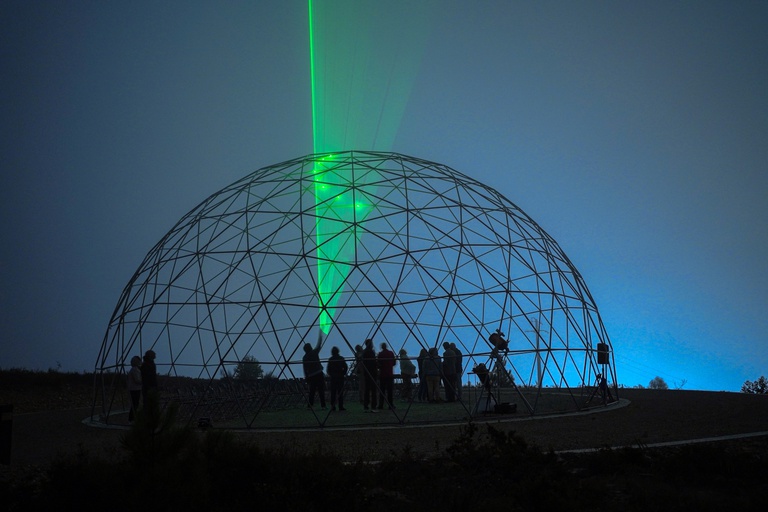
In the Aldeias do Xisto (Schist Villages), recognised as a Starlight Tourist Destination, the sky is a living heritage. Low light pollution, combined with specialised observation equipment, makes Geoscope - Fajão Astronomical Observatory one of the best places in Portugal to observe the sky. Part of the Starlight Schist Villages project, this space invites you to discover the universe in the heart of nature.
You can consult and schedule activities dedicated to astronomy, as well as book associated stays, through Bookinxisto.
The main astronomical phenomena of 2026
3 to 4 January: Quadrantid meteor shower
The year begins with the Quadrantids, a meteor shower known for its short and intense peak. In 2026, the full moon on the night of 3 January will make it difficult to observe the weaker meteors, so no great visual spectacles are expected. Still, a brighter fireball may occasionally appear.
29 January: Conjunction between Venus and Mercury
At the end of January, Venus and Mercury appear very close together in the evening sky, visible in the west shortly after sunset. An interesting planetary encounter for naked-eye observation and photography, provided the horizon is clear.
March: Total lunar eclipse
In the early hours of 3 March, there will be a total lunar eclipse, also known as a ‘Blood Moon’. The phenomenon will be visible mainly in North America and other regions of the globe, but will not be observable in Portugal. During a lunar eclipse, the Earth casts its shadow on the Moon, giving it reddish tones, resulting from sunlight filtered by the Earth's atmosphere.
April: Lyrids
Between 21 and 22 April, the Lyrids mark the return of spring meteor showers, ideal for observation in dark places with a wide horizon.
May to July: active skies
The Eta Aquariids peak on 5 and 6 May, followed by the Delta Aquariids, peaking on 30 and 31 July, offering good meteor rates per hour, especially in the early hours of the morning without the moon.
21 June: Summer solstice
The summer solstice occurs on 21 June, marking the longest day of the year in the northern hemisphere. From this date onwards, the days slowly begin to shorten, although the astronomical summer is only just beginning.
August: an exceptional month
August brings some of the most eagerly awaited moments of the year:
- 12 August – Total solar eclipse, visible in a small area of north-eastern Portugal, with a high degree of obscuration throughout the country
- 12–13 August – Perseids, considered one of the best meteor showers of the year, benefiting from the New Moon
- Planetary alignments, visible before sunrise, with several planets observable to the naked eye
This will undoubtedly be one of the most intense periods in the 2026 astronomical calendar.
October and November: Orionids and Leonids
The Orionids (21 to 22 October) and Leonids (16 to 17 November) keep the sky busy in autumn, with fast meteors and well-defined luminous trails.
December: Geminids and Ursids
The year ends on a high note with the Geminids (13 to 14 December), which promise a spectacular show, followed by the Ursids (21 to 22 December), close to the winter solstice.
21 December: Winter solstice
The winter solstice occurs on 21 December, marking the shortest day and longest night of the year. This moment signals the beginning of astronomical winter and the gradual return of longer days.
Among mountains, schist villages and absolute silence, observing the universe becomes a return to the essentials — an invitation to slow down, learn and marvel at the immensity of the cosmos.
In 2026, the best place to look at the sky... is on Earth.